
CNC (Computer Numerical Control) machining is a manufacturing process in which computer-controlled cutting tools remove material to create a specified shape. In jewelry manufacturing, it can be used to produce master models, machine selected features, or directly manufacture certain finished components.
For 316L stainless steel jewelry, CNC machining is particularly useful when a design requires precise dimensions, symmetrical shapes, defined edges, or accurately positioned holes and slots.
Unlike investment casting, which forms a component by pouring molten metal into a prepared mold, CNC machining shapes material through controlled cutting. The best method depends on the design, required detail, production quantity, and target cost.
The process starts with a CAD drawing or 3D model. Dimensions, thickness, contours, holes, grooves, and other important features are reviewed before production.
For wholesale jewelry projects, early technical evaluation helps identify features that may be difficult or expensive to machine. Tool access, material thickness, and the required surface finish can all affect manufacturing cost.
[图片2:CAD三维饰品设计图与对应的316L不锈钢实物对比图。]
The approved design is converted into machining instructions using CAM software. The programmer selects suitable cutting tools and defines the toolpaths, cutting sequence, and machining parameters.
The stainless steel workpiece is then securely positioned in the machine. Proper setup is important for maintaining dimensional accuracy and consistency between parts.
The CNC machine follows the programmed toolpaths to remove material from the workpiece. Depending on the design, milling or turning may be used to create the required geometry.
In jewelry production, CNC machining can be suitable for signet rings, selected bracelet components, clasps, pendants, and parts requiring precise holes, flat surfaces, or defined contours.
However, CNC is not automatically the best choice for every design. Highly sculpted shapes, deep undercuts, and intricate decorative forms may be more practical to produce through investment casting or a combination of processes.
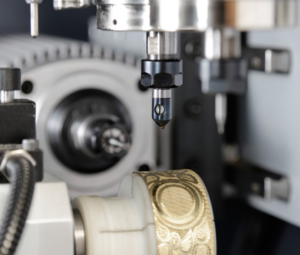
[图片3:CNC刀具正在加工金属戒指或吊坠,展示切削过程及金属工件。]
After machining, sharp edges and burrs are removed. The component may then undergo grinding, polishing, brushing, or other surface-finishing processes.
For products requiring PVD plating, surface preparation is especially important because machining marks and finishing defects can affect the final appearance.
Quality inspection should focus on the dimensions and features that matter to the product, as well as surface quality, fit, and consistency across the batch.
[图片4:CNC加工后的不锈钢饰品、边缘处理和抛光前后对比图。]
CNC machining can serve two different roles in jewelry production.
CNC-machined master models: CNC equipment can produce a precise master model or tooling component used in a subsequent molding and casting process. This can help reproduce design details consistently during production.
Direct CNC machining: The machine can also cut the finished component from stainless steel stock. This approach may suit parts requiring precise geometry, but material removal time and finishing requirements can increase the unit cost.
For some designs, a combined approach is more practical: CNC machining creates the master model or critical features, while casting produces the main shape. The suitable route should be evaluated according to the product structure and order quantity.
[图片5:左侧展示CNC加工的母模,右侧展示通过后续铸造和表面处理完成的饰品,用简洁箭头连接。]
| Process | Suitable applications | Key consideration |
|---|---|---|
| CNC Machining | Precision features, defined contours, master models, selected solid components | Machining time, tool access, and material removal |
| Investment Casting | Complex 3D shapes and sculpted details | Wax patterns, shell preparation, and finishing |
| Laser Cutting | Flat profiles, openwork, and detailed outlines | Sheet thickness and edge finishing |
| Stamping | Repeatable shapes formed from sheet metal | Tooling cost and design suitability |
These processes serve different purposes and are not interchangeable in every application. A manufacturing review can help determine whether one process or a combination will provide the best balance of quality and cost.
[图片6:CNC Machining、Investment Casting、Laser Cutting、Stamping四种工艺的简易对比图,沿用 J-Focus 统一的工艺插图风格。]
To evaluate a custom 316L stainless steel jewelry project, buyers should provide:
Providing these details early helps the manufacturing team assess feasibility, estimate costs, and recommend a suitable production route before sampling.
Yes. CNC machining can process 316L stainless steel for components that require defined geometry and precise features. Tool selection, machining parameters, and finishing need to be appropriate for the material and design.
Not necessarily. CNC machining can provide precise control over accessible machined features, while casting can reproduce complex overall shapes. The achievable accuracy depends on the process, design, tooling, and quality controls.
It can be, particularly for parts with repeatable geometry. However, machining time and material removal may make direct machining less economical than casting or stamping for some high-volume jewelry orders.
Choosing the right manufacturing process starts with understanding the design, material, quality requirements, and target quantity.
J-Focus works with production partners to evaluate custom 316L stainless steel jewelry projects and coordinate suitable manufacturing solutions for wholesale customers.
Contact J-Focus with your design or reference images to discuss your project and request a quotation. We aim to respond within 24 hours.