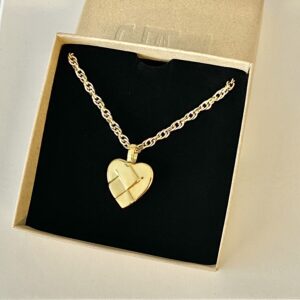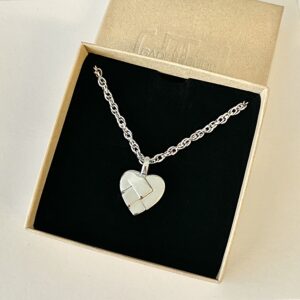
Investment casting is also known as lost-wax casting. It helps manufacturers produce 316L stainless steel jewelry with complex shapes and detailed designs. The process works well for rings, pendants, earrings, and decorative components.
Unlike laser cutting, investment casting can create three-dimensional shapes and raised details. However, the right process depends on the design, order quantity, surface finish, and target cost.
At J-Focus, we evaluate these factors before recommending a manufacturing solution. Our goal is to help wholesale customers develop practical designs and achieve consistent production quality.
The investment casting process uses a wax pattern to create a cavity for molten metal. First, manufacturers make the wax pattern. Next, they build a heat-resistant shell around it. Finally, they remove the wax and pour molten stainless steel into the cavity.
This process is suitable for several types of stainless steel jewelry, including:
For wholesale projects, investment casting offers greater design flexibility than many flat-sheet processes. However, the design still needs to meet casting and finishing requirements.
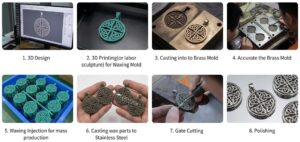
The process typically involves five main steps.
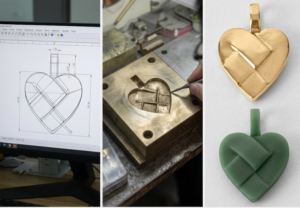
First, the customer provides a CAD drawing, 3D model, sketch, or reference sample. The manufacturing team reviews the dimensions, thickness, and structural details.
Next, a suitable mold produces the wax patterns. These patterns reproduce the shape of the final jewelry piece. Manufacturers can then connect multiple patterns to form a wax tree.
Accurate wax patterns help improve dimensional consistency and surface detail.
Next, workers coat the wax tree with refractory materials. These coatings form a heat-resistant shell around the patterns.
After the shell hardens, heating removes the wax. This leaves a cavity that matches the jewelry design.
Careful shell preparation helps the metal fill the cavity and reproduce the required details.
The next step is metal casting. Manufacturers pour molten stainless steel into the prepared shell. Once the metal cools and solidifies, they remove the shell to reveal the cast components.
For 316L stainless steel jewelry, the design, shell quality, and casting conditions all affect the result. Thin sections and intricate details may need extra evaluation before production.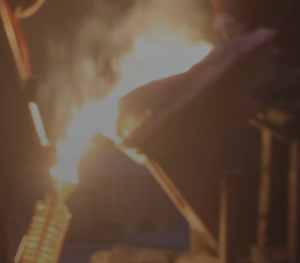
After casting, workers separate the components from the casting tree. They remove gates and excess material, then grind and polish the surfaces.
Depending on the design, the product may also require stone setting, engraving, enamel filling, or assembly.
For PVD-plated jewelry, surface preparation is especially important. Scratches and uneven surfaces can affect the final appearance.
[图片3:展示切除浇口、打磨抛光,以及完成后的316L不锈钢饰品对比图。]
Before shipment, the finished components need a quality check. Inspectors compare the products with the approved drawing or sample.
Key inspection points include:
Clear quality standards help reduce variation across repeat orders.
Several factors affect the quality and cost of cast jewelry.
Complex contours, deep recesses, and thin sections can make casting more challenging. Therefore, a design review before tooling can help identify potential problems early.
Cast components often need grinding and polishing. The required finishing time depends on the initial surface quality and the final appearance.
For example, polished or PVD-plated jewelry may require more careful surface preparation.
The wax pattern, shell preparation, casting process, and finishing can all affect final dimensions. For this reason, buyers should identify critical measurements before sampling.
Wax-pattern tooling involves an upfront investment. However, repeat orders may help spread this cost across larger production volumes.
The best solution depends on the design, order quantity, and finishing requirements.
Different jewelry designs require different manufacturing methods. The following comparison highlights their main applications.
| Process | Best suited for | Key consideration |
|---|---|---|
| Investment Casting | Complex 3D shapes and raised details | Tooling, casting quality, and finishing |
| Laser Cutting | Flat profiles and openwork designs | Edge quality and post-cut finishing |
| Stamping | Repeatable sheet-metal shapes | Die cost and design suitability |
| CNC Machining | Precision features, holes, and selected solid parts | Machining time and material removal |
For example, investment casting suits sculpted pendants and rings. In contrast, laser cutting works well for flat outlines and openwork designs. Stamping can be efficient for repeatable sheet-metal components, while CNC machining suits parts that require precise features.
Therefore, the best process depends on the actual design rather than the product category alone.
Before requesting a quotation, wholesale buyers should prepare the following information:
If you do not have a final CAD drawing, reference images and key dimensions can still help start the discussion.
Early evaluation can identify design issues before sampling. It also helps the team estimate tooling, production, and finishing costs more accurately.
Yes. Investment casting can produce 316L stainless steel jewelry with complex three-dimensional shapes. The design and finishing requirements must suit the process.
No. Investment casting uses a wax pattern and a removable heat-resistant shell. Conventional die casting injects molten metal under pressure into a reusable metal die. Although some jewelry manufacturers use the term “die casting mold” for wax-pattern tooling, the actual production steps determine the process name.
Yes. Manufacturers can apply PVD coating after suitable finishing and surface preparation. The final appearance depends on surface quality and coating control.
Yes. It can support repeat production of complex jewelry designs. However, buyers should consider tooling costs, finishing requirements, order quantity, and quality consistency.
Choosing the right manufacturing process helps balance design, quality, and production cost.
With more than a decade of experience in stainless steel jewelry, J-Focus works with production partners to evaluate designs and coordinate suitable manufacturing solutions for wholesale customers.
Have a new jewelry design? Contact J-Focus with your drawings, reference images, and order requirements. We aim to respond to quotation requests within 24 hours.