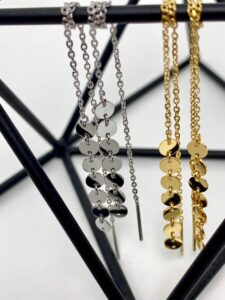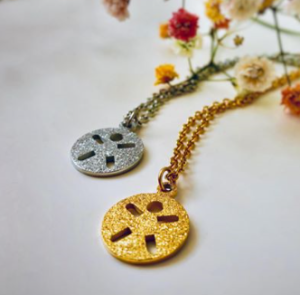
Laser cutting is widely used in 316L stainless steel jewelry manufacturing to create precise outlines, decorative patterns, and detailed cutouts. It is particularly suitable for flat metal components with complex shapes or openwork designs.
For jewelry wholesalers and designers, choosing the right manufacturing process is important for balancing design requirements, production costs, and finished quality. Understanding how laser cutting works can help determine whether it is the right choice for a jewelry project.
Laser cutting is suitable for designs made from flat stainless steel sheets that require precise outlines, openings, or decorative patterns.
Common applications include:
Before selecting this process, consider three important factors:
Design Structure
Laser cutting works well for two-dimensional designs with detailed outlines. If a design requires complex three-dimensional shapes, investment casting or die casting may be more suitable.
Material Thickness
The thickness of the 316L stainless steel sheet affects cutting accuracy and the final appearance. It should be selected according to the component size, structure, and strength requirements.
Production Quantity
Laser cutting does not require dedicated stamping dies, making it suitable for customized designs, prototypes, and projects that need flexible design adjustments.
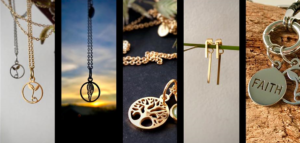
The production process generally involves five steps, from design preparation to final inspection.
The process starts with a CAD drawing or digital design file. Dimensions, material thickness, hole positions, and cutting details are reviewed to ensure the design is suitable for laser cutting.
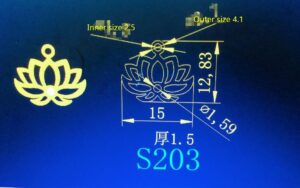
316L stainless steel sheets are selected according to the design requirements. Material thickness, flatness, and surface condition are checked before cutting.
The machine follows the programmed cutting path to create the required shapes and openings. Proper laser power and cutting speed help achieve accurate dimensions and clean edges.
After cutting, the components are separated from the metal sheet. Edges are processed to remove burrs and sharp areas.
Further finishing may include machine polishing, hand polishing, brushed finishing, and cleaning before PVD coating.
Finished components are checked against approved drawings and samples. Inspection focuses on dimensions, edge smoothness, flatness, surface condition, and shape consistency.
Several factors influence the quality of laser-cut stainless steel jewelry.
Cutting Accuracy: Small holes, narrow openings, and detailed patterns require careful design evaluation to maintain dimensional accuracy.
Edge Quality: Cutting residue and burrs must be removed to achieve smooth edges and comfortable wear.
Surface Finish: Polishing and cleaning are important before PVD coating to ensure a consistent final appearance.
Dimensional Consistency: Components should be checked against approved drawings to maintain consistency throughout production.
Laser cutting usually produces the basic flat metal component rather than the complete jewelry piece.
Depending on the design, additional processes may include bending, welding, assembly, stone setting, polishing, and 14K or 18K PVD coating.
The final manufacturing route depends on the product structure and desired appearance. Evaluating these steps before production helps avoid unnecessary processing and improves overall efficiency.
At J-Focus, we evaluate 316L stainless steel jewelry designs based on their structure, material thickness, production requirements, and finishing details.
With more than a decade of experience in stainless steel jewelry manufacturing, we focus on selecting practical production methods and maintaining quality throughout the manufacturing process.
Have a design in mind? Send us your drawings or reference images to discuss the most suitable manufacturing process.